The UK is in the middle of an extreme heatwave. And most homes here were never designed for it.
The Met Office has issued a Red Extreme Heat warning — the highest alert level — with temperatures forecast to reach 38°C across parts of England and Wales this week. Met Office Deputy Chief Forecaster Mark Sidaway described it as a severe weather event: "The combination of heat and humidity will be oppressive and bring impacts across society from public health and infrastructure, to power and water supplies. As well as very high daytime temperatures, there will be consecutive nights where temperatures do not drop below 20°C — called a Tropical Night. This will make it very hard for people to recover from the daytime heat, exacerbating the heat stress impacts."
For the majority of the year, the priority in British residential architecture is retaining heat — dense brick construction, low ceiling heights, wall-to-wall carpet, south-facing glazing with no shading. All of it works well for a cold, damp climate. All of it becomes the problem when temperatures climb.
Continental European homes — particularly in France, Spain, and Italy — are built for the inverse: thick stone walls with high thermal mass, external shutters, high ceilings, tiled or stone floors. Those features are not decorative. They are climatic responses, developed over centuries.
The UK is catching up slowly. In the meantime, here is what actually makes a difference — the design and material decisions that determine how a home behaves when the heat arrives.
Michael Moran, Director, Meiger
This is not a temporary inconvenience. It is a structural issue with the UK’s housing stock, and the data is unambiguous.
According to analysis by Arup, commissioned by the Climate Change Committee, half of all UK homes currently face overheating risk under existing weather conditions. The Climate Change Committee now projects that 92% of UK homes could face overheating by 2050 without adaptation measures — up from just over half today.
The English Housing Survey 2023–24 found that 2.9 million households reported their home got uncomfortably hot in that year alone. Notably, newer homes built post-2012 — designed to be airtight for energy efficiency — were more likely to report overheating than older homes. The very improvements that keep heating bills down in winter can trap heat in summer without a corresponding ventilation and shading strategy.
Professor Anna Mavrogianni from University College London’s Institute for Environmental Design and Engineering has noted that "overheating in UK homes is not a future problem, but a current and ongoing issue, in particular in more energy efficient, newly built constructions, which will be exacerbated as our climate becomes warmer."
Professor Stephen Belcher CBE, Met Office Chief Scientist, put it plainly this week: "To see temperatures like this in the UK in June is sobering. Events like this bring home the implications of climate change." Met Office projections indicate that hot spells will become more frequent, particularly across the south-east of the UK.
This is the most common mistake, and it is understandable.
In a UK heatwave, the air outside during peak hours — typically 10am to 6pm — is hotter than the air inside a well-built home. Opening south and west-facing windows during the day imports heat, not cool air. The building envelope is acting as insulation. Opening it defeats the purpose.
The Met Office confirms this directly in its own guidance: closing curtains or blinds in sun-facing rooms and keeping windows shut during the hottest part of the day helps retain cooler air inside. Opening windows in the evening, when external temperature drops below internal, is when cross-ventilation becomes useful.
What to do instead:
Close all south and west-facing windows and doors before 9am. Keep them closed through the hottest part of the day. After sunset, when external temperature drops below internal temperature, open everything — particularly on opposite sides of the building to create cross-ventilation.
Most people do the inverse. Reversing this one habit makes a significant difference in any existing home, immediately and at no cost.
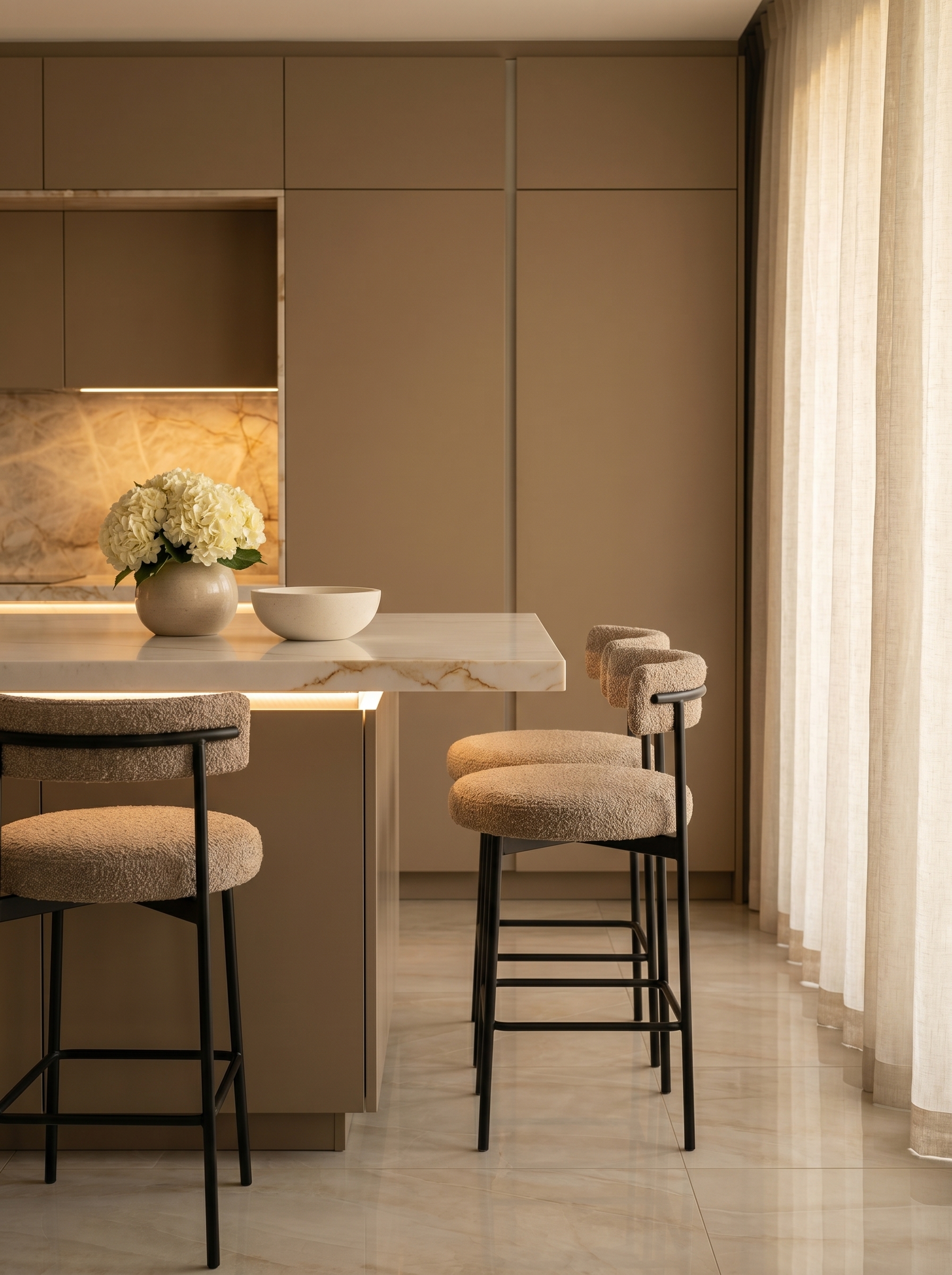
Stone, concrete, and tile absorb heat slowly during the day and release it overnight. This is thermal mass — and it is the reason a stone-floored room stays noticeably cooler than a carpeted one through a heatwave.
Honed natural stone — limestone, travertine, or marble — over a concrete subfloor performs particularly well. The combined thermal mass of stone and concrete screed absorbs heat through the day and dissipates it overnight, stabilising the internal temperature without any mechanical intervention.
Carpet, engineered timber, and LVT over a timber subfloor have minimal thermal mass. They heat up quickly and retain that heat. In rooms where overheating is a consistent problem, this is often the primary cause.
If you are planning a ground-floor renovation, specifying natural stone over concrete screed is the single most impactful thermal decision you can make. It is also the decision that defines the material quality of the room — the two goals are the same specification.
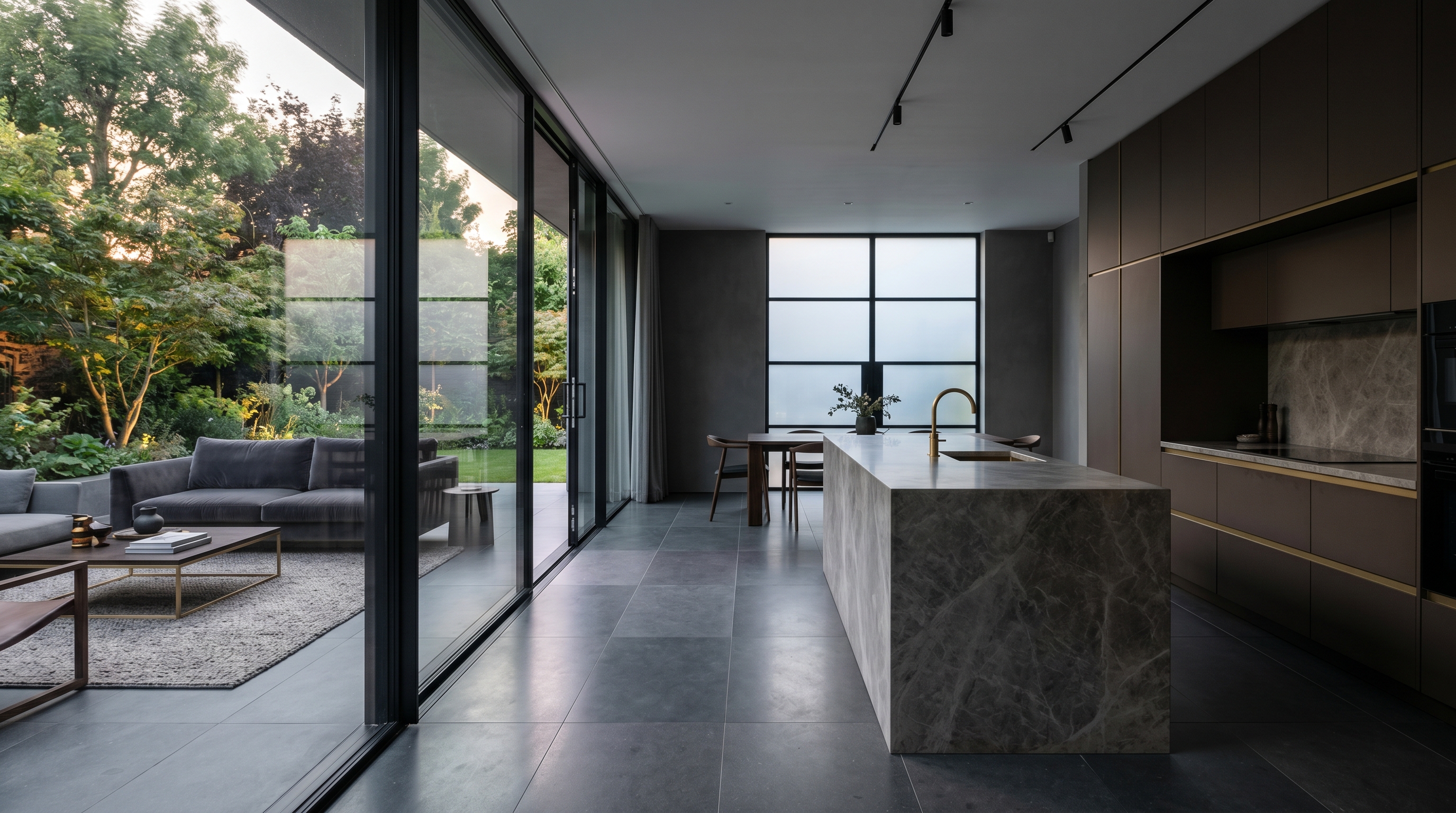
South and west-facing glazing without solar control is the biggest contributor to overheating in modern UK homes. Standard double glazing transmits a significant proportion of solar energy as heat. Solar control glass — specified with a low g-value — reduces that solar heat gain substantially while maintaining light transmission.
What to ask for: On south and west-facing elevations, specify glazing with a g-value below 0.35. This is a decision made at window specification stage. It cannot be retrofitted without replacing the glass unit.
There is an important nuance here. As one specialist glazing analysis noted in 2026, "a lower g-value reduces overheating risk, yet if over-specified, it can limit useful passive warmth during colder months. Balance is essential. Orientation dictates much of the strategy." West-facing glazing often requires particular attention due to intense afternoon heat — something frequently underestimated at design stage.
For existing homes: External blinds, louvres, or fixed brise-soleil stop solar energy before it enters the building. Internal blinds trap heat between the blind and the glass — they help marginally. External shading is the effective solution. The difference in performance is not marginal.
Deep window reveals — a feature of older stone-built homes — serve the same function naturally. The reveal shades the glass during high summer sun angles and admits light in winter when the sun is lower. It is a passive solar shading device. Modern homes with flush-frame windows and no reveal have eliminated this by accident.
Sean Ronnie Hill, Director at RISE Design Studio, has observed exactly this pattern in London’s existing housing stock: "Over the past two decades, many homes have been sealed tightly in the pursuit of energy efficiency. Draught-proofing, double glazing, and airtight construction have dramatically improved winter performance. But without proper ventilation, shading, and solar control, many homes now struggle during hotter months. Large glazed extensions facing west or south-west, poorly shaded rooflights — technology works best when paired with good passive design rather than used to compensate for poor orientation or excessive solar gain."
Hot air rises. A room with a standard 2.4m ceiling traps warm air at head level. A room with 2.7m or 3m of ceiling height allows that warm air to stratify above the occupied zone, keeping the lower portion of the room cooler.
This is not a retrofit solution. But in any conversion, extension, or new build, every additional 100mm of ceiling height in a south-facing room makes a measurable difference to summer comfort — and a considerable difference to how the room feels year-round.
At Meiger, ceiling height is one of the first spatial decisions we protect in a brief. The temptation to use ceiling voids for services or to reduce structural cost is always present. The case for keeping the height is thermal as well as architectural.
.jpeg)
A single window moves warm air around a room. Windows on opposite sides of a room — or opposite ends of a building — create a pressure differential that draws cool air through.
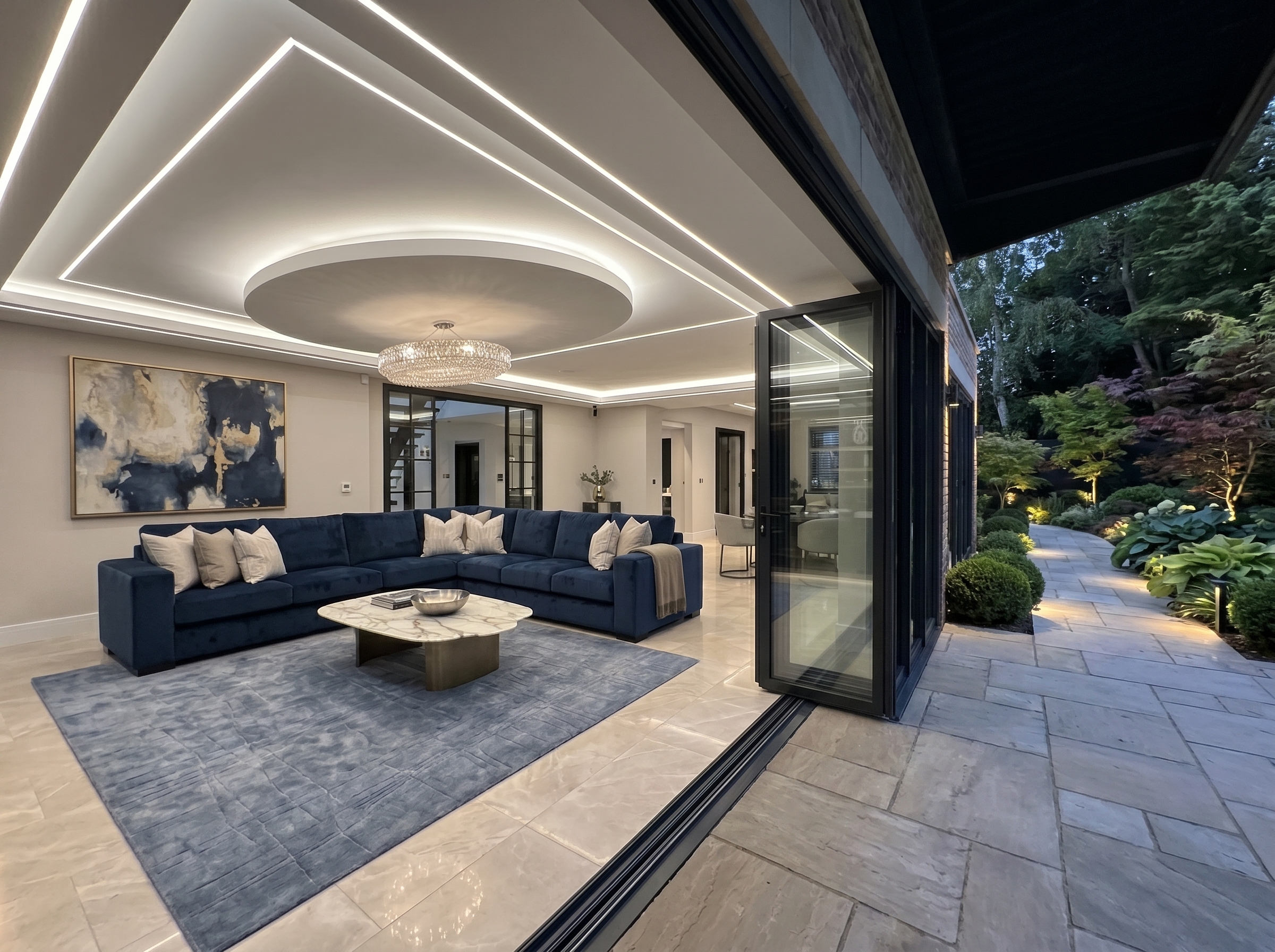
An open-plan ground floor, properly oriented, ventilates far more effectively than a series of closed rooms. The removal of internal walls that creates the open-plan living environment also removes the barriers to natural airflow. This is one of the less-discussed benefits of open-plan renovation — the thermal performance as well as the spatial one.
For cross-ventilation to work: open windows on the cooler elevation (typically north-facing) and at the highest point of the building. Cool air enters low and north; warm air exits high. The differential pulls fresh air through without mechanical assistance.
Allan Corfield Architects, whose practice focuses on low-energy residential design, advise treating "shading and ventilation as core design features — overheating risk is now a major part of creating comfortable low-energy homes" — and critically, that these decisions need to be made from the first sketch, not retrofitted into an otherwise complete design.
The decisions that make the greatest long-term difference are all made before construction begins. Retrofitting them later is significantly more expensive and, in some cases, not possible at all.
SpecificationWhat it doesSolar control glazing — g-value below 0.35Reduces solar heat gain on south and west elevationsNatural stone flooring over concrete screedThermal mass absorbs and stabilises daily temperature swingsExternal shading — louvres, deep reveals, or brise-soleilStops solar energy before it enters the glassCeiling height — 2.7m minimum in habitable roomsAllows warm air to stratify above the occupied zoneOpen-plan ground floorRemoves barriers to cross-ventilationMechanical ventilation with heat recovery (MVHR)Controlled ventilation in airtight, well-insulated new builds
None of these are expensive additions when specified at the right stage. All of them become considerably more expensive — or impossible — when raised after construction has begun.
The UK government’s Warm Homes Plan acknowledges the problem directly: "Our buildings are not currently built to deal with record summer temperatures and some are at significant risk of overheating." The Future Homes Standard, coming into full force in December 2026, introduces Part O — a new section of Building Regulations specifically addressing overheating — as a legal requirement for new builds. For existing homes undergoing renovation, the direction of travel is the same: design for both winter efficiency and summer resilience simultaneously.
There is no single fix. A home that performs well in a UK heatwave is one where several decisions — material, glazing, height, ventilation — work in the same direction. Most UK homes have none of them by design. A considered renovation can introduce several in a single project.
Thermal performance and design quality are not competing priorities. The same decisions that keep a home cool in summer — stone floors, high ceilings, considered glazing, open plan — are the decisions that make a home worth living in year-round.
If you are considering a renovation and want thermal performance to be part of the brief, raise it at first meeting. The decisions that matter most are the first ones made.
Michael Moran is Director of Meiger, a contemporary luxury interior design studio based in Cheshire serving clients across the North West and beyond. To discuss a renovation project, contact the studio at hello@meiger.co.uk or on +44 (0)161 531 8385.