When most people think about interior design, they think about furniture — fabric selections, finishes, the arrangement of objects in a finished room. Michael Moran, founder of Meiger, a turnkey interior design studio working across Cheshire, Manchester, and the wider North West, begins somewhere else entirely.
"We start here," he says — and gestures at the space around him.
The room is in Alderley Edge. It is nearly ready for its final touches for the guest room and lougne area: Gaggenau appliances waiting to be fitted, a curved ceiling and wall panel yet to close, a custom table being manufactured off-site for the seating area. To most eyes, it looks unfinished. To Moran, it is a room that already knows what it is. The furniture, when it arrives, will confirm that. It will not define it.
Architecture-led interior design is not a style. It is a sequence — a decision about what gets resolved first, and why.
At Meiger, the process begins with the structure of the space: the fixed elements that will outlast every furniture refresh and every trend cycle. Ceiling profiles. Wall geometry. Where light enters and where it lands. The threshold between rooms. The depth of built-in joinery. The material that defines one zone from the next without requiring a partition.
"The room exists before the furniture arrives," Moran explains. "The furniture arranges itself around what we've built. If the architecture is right, the room already knows what it is before a single chair or wallpaper is chosen."
This is a fundamentally different model from the decorator-led approach that most clients have encountered — one in which surfaces are selected after the space has been handed over, and the interior is treated as a layer applied to an existing shell. Architecture-led design treats the shell as the design. The decisions that compound over decades — ceiling profile, material junction, integrated light — are resolved first. Everything visible follows from them.
Meiger's projects typically span between one thousand and three thousand square metres. At that scale, the challenge is not simply one of size. It is one of coherence.
"Unlocking space, at this level, is about harmonisation," Moran says. "A large property without spatial logic does not feel generous. It feels unresolved. The rooms don't belong to each other. You move through them without knowing why."
The studio's approach to large-scale residential work is rooted in proportion and spatial hierarchy — understanding which rooms anchor the plan, how circulation connects them, and where restraint serves the architecture better than intervention. Every zone within a scheme, regardless of the property's overall footprint, is given a considered brief of its own.
The guest kitchen and lounge within a current Cheshire commission illustrates this precisely. The room sits inside a substantial mansion — the property as a whole runs well over a thousand square metres — yet the zone itself operates within a more intimate footprint. The brief was to make it work for entertaining, for ease, for warmth, while maintaining the material language and formal register of the wider home.
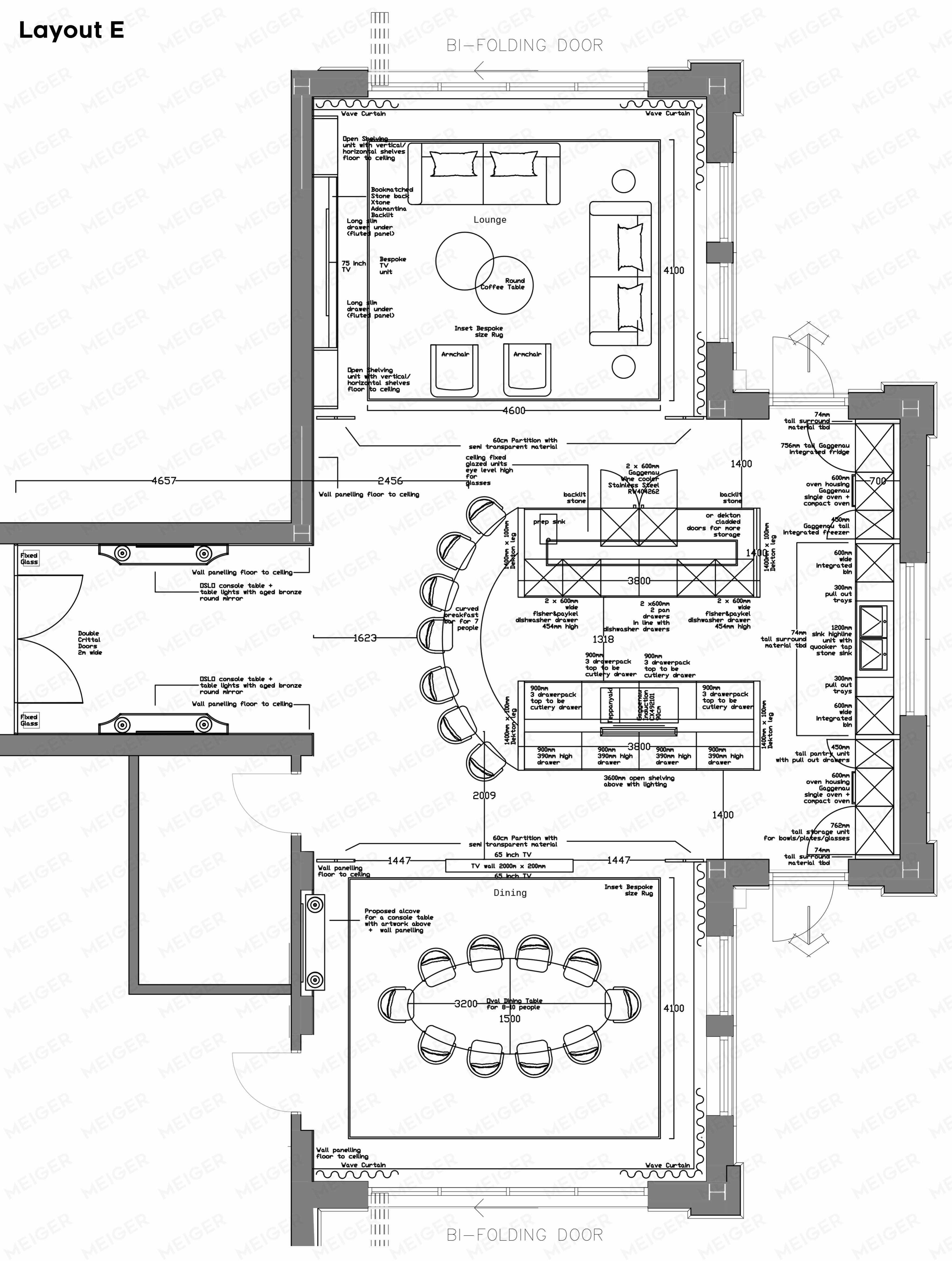
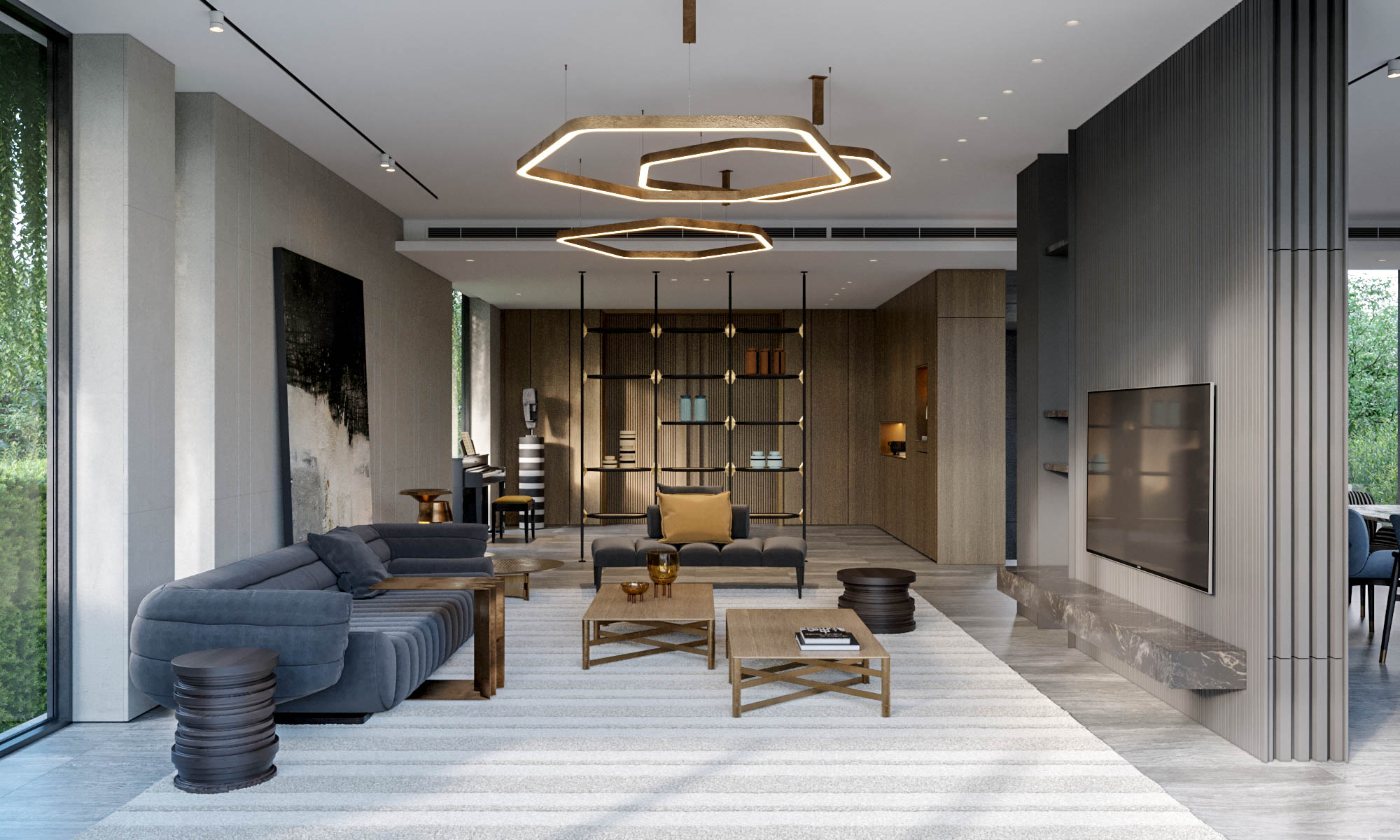
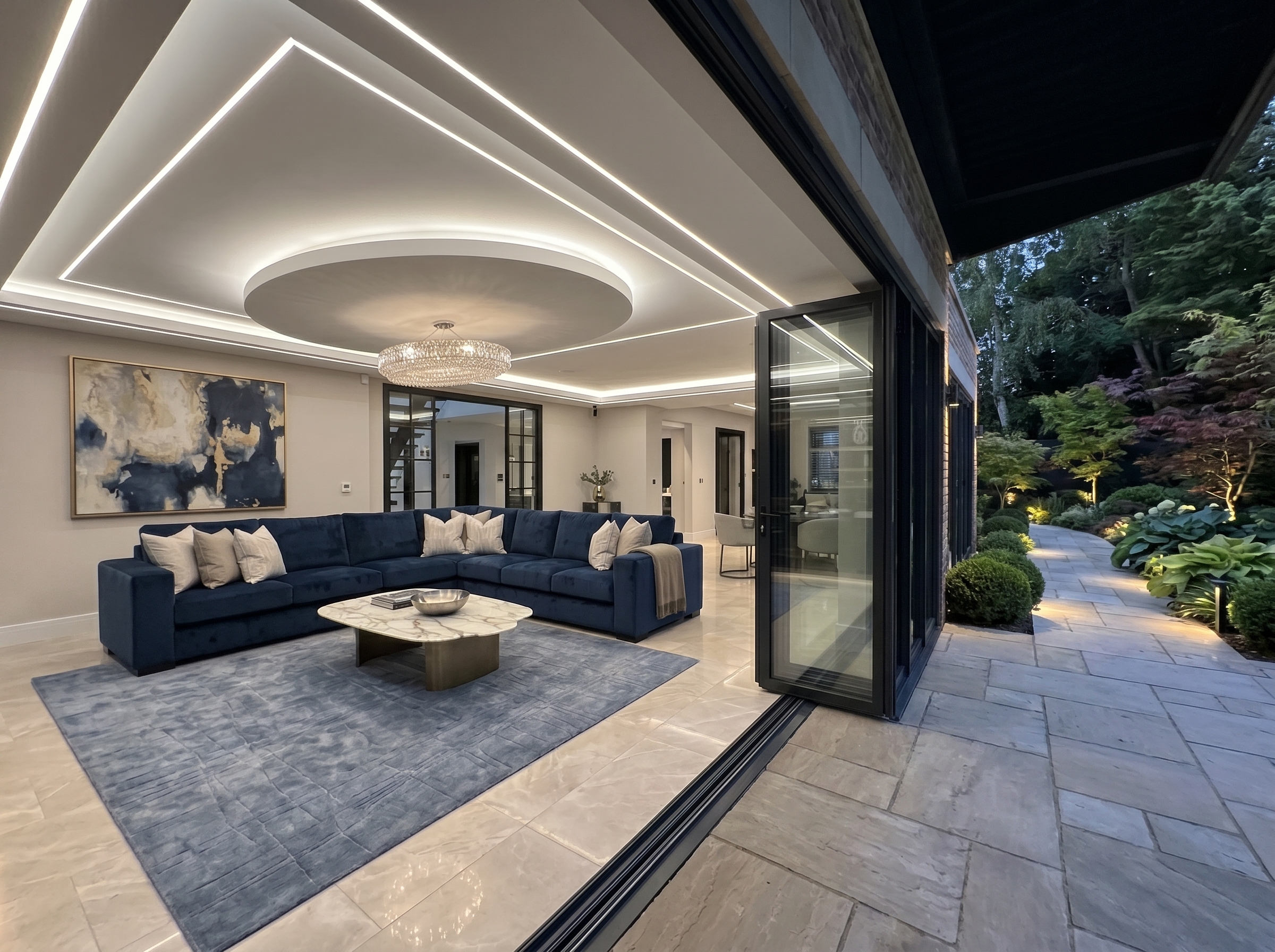
The answer was not to scale down the ambition. It was to resolve the spatial tensions directly. The sofa zone is defined by a recessed carpet within the tiled floor — a material boundary rather than a physical partition, keeping the room open while giving each area legibility. The TV wall, finished in fluted stone, gives vertical depth to the elevation without crowding the space. Panelling runs the full perimeter; LED uplighting sits above it, invisible as a source, washing the ceiling from a position of architectural integration rather than decorative addition. The room entertains. It breathes. It belongs to the house.
Meiger's material specifications are chosen against a single criterion: how does this decision age?
Not durability alone — though that matters — but relevance over time. Materials that develop character rather than date. Surfaces whose logic holds as clearly in thirty years as it does on the day of completion.
The studio works with some of Europe's foremost residential material suppliers — leading manufacturers from Germany and Italy whose product standards are exacting and whose manufacturing expectations are, by design, rigorous. Working at that level means understanding where the tolerances lie — and occasionally working beyond them.
The fluted stone TV wall on the Alderley Edge project is a case in point. It is the first time Meiger has used the material in this configuration. "It's proven to be a little problematic from a manufacturing point of view," Moran says, without apology. "Stone doesn't like a tight radius. Getting the fluting to run cleanly took several conversations with the fabricator. That's the standard at this level. The alternative is to simplify the design. We don't do that."
.png)
The curved ceiling panel in the same room — a continuous radius that carries from the wall surface up and over the ceiling as a single unbroken element — operates on the same principle. It removes the seam between the two planes. The room becomes a volume rather than a box with a lid. The curve was designed. It is not decorative. It is structural in intention. When the Gaggenau appliances arrive — 760 millimetre ovens from the new range, specified from the outset — they will fit a kitchen that was sized around them. The appliance did not determine the room. The room was resolved, and then the appliance was matched to it.
For many Meiger clients, the relationship begins long before a design brief is signed, a budget is confirmed, or a planning application is submitted.
At this level of project scale and complexity, the studio operates less as a conventional service provider and more as a long-term design advisor — a trusted expert whose understanding of a client's standards, lifestyle, and vision deepens across conversations that may span months or years before any work formally begins.
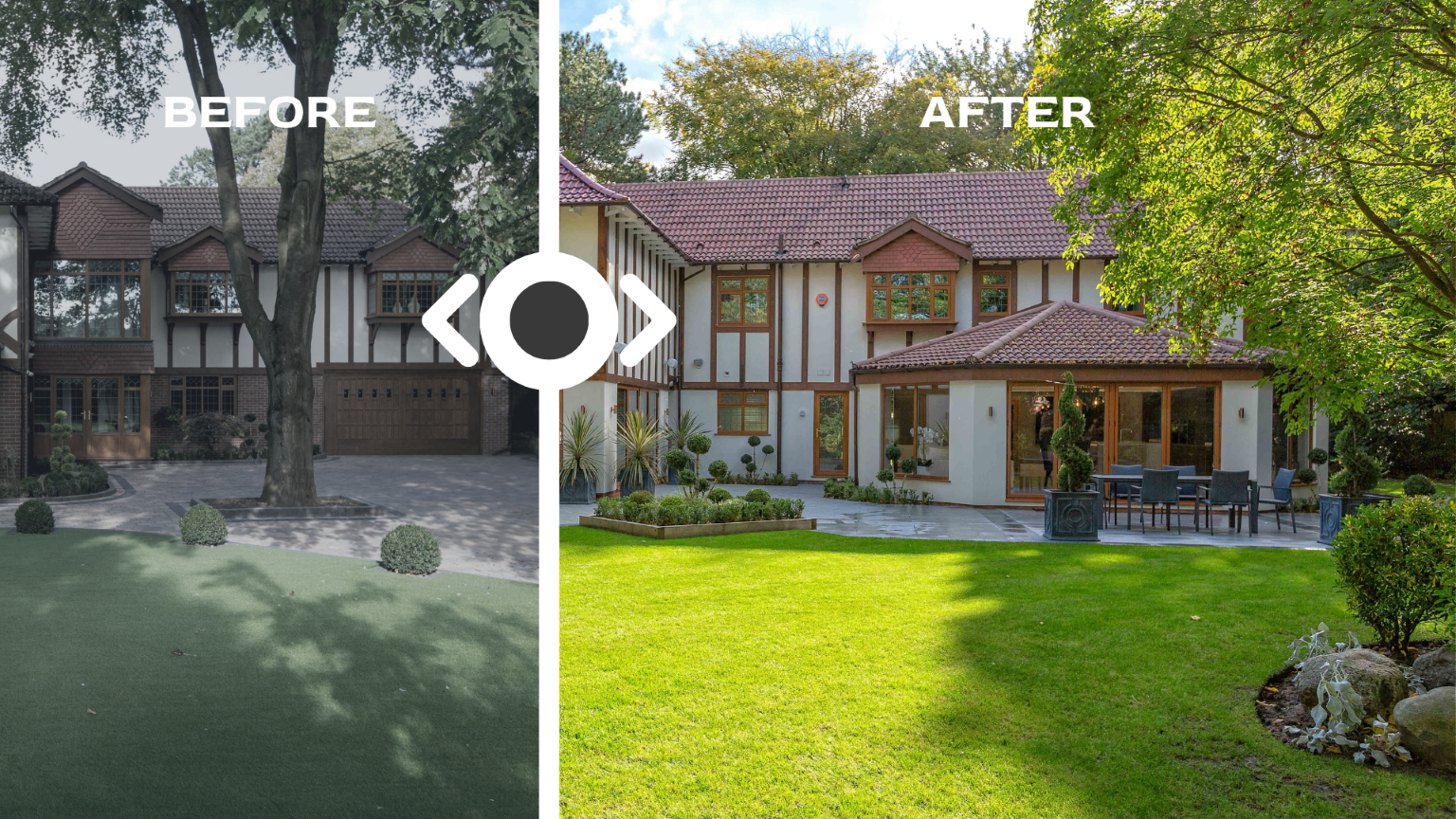
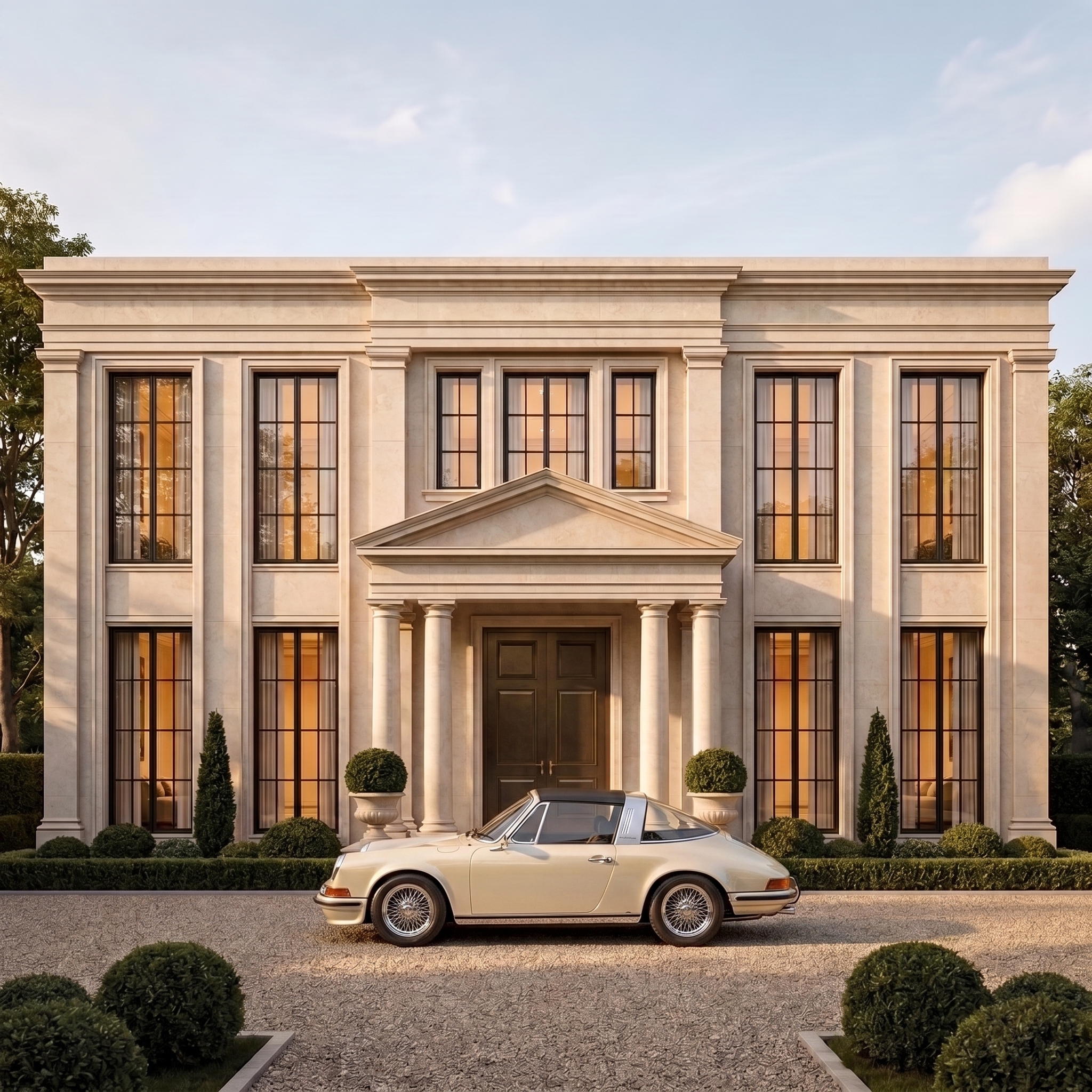
Tom — a developer and solicitor, and the owner of the Formby Beach Neo-Classic Residence — first approached Moran over a year before the project started on site.
"Meiger is the main interior design company for my house project, but we were talking long before that. He also worked on the two houses next door to mine in Victoria Road Residence, and everyone involved has been satisfied — not just with the level of expertise in the team, but with Michael's precision, his perfectionism, and how practically he approaches problems. My work and business life are pretty relentless. Working with Meiger just chased the worry away."
— Tom, developer and solicitor, Formby Beach Contemporary Residence
That trust is not assumed. It is built — through the quality of initial conversations, through the rigour of the process, and through the consistency of what is delivered. For clients considering a whole-house commission — a project that will take months, often longer, and require hundreds of resolved decisions — the question of who they can rely on across that period matters more than almost anything else.
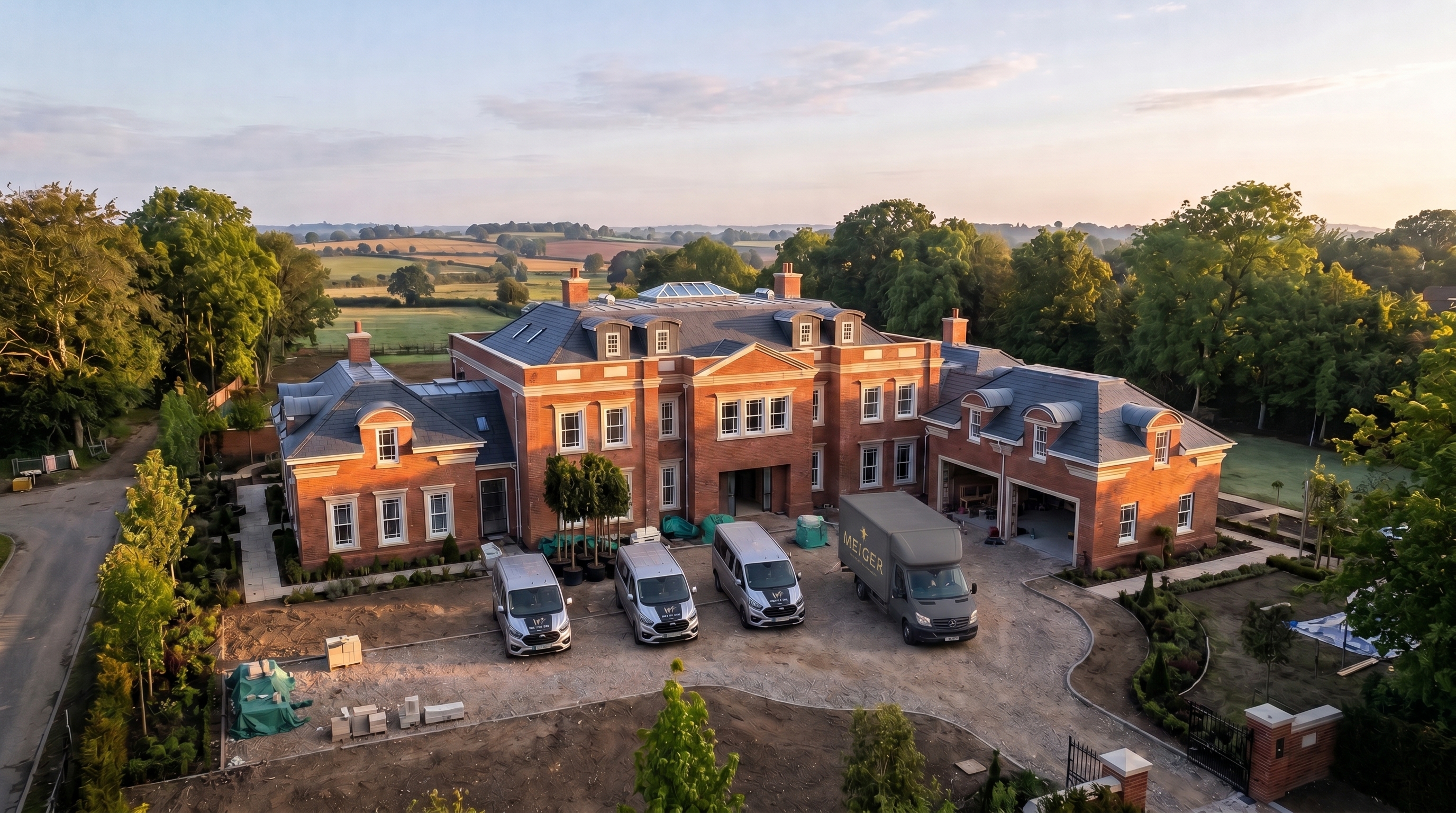
There is a ceiling to how many projects Meiger takes on at any one time, and that ceiling is deliberate.
"The number of projects is never the KPI," Moran says. "Working with clients at this level means accepting that timelines are long and that some things will need to be done again before they are done right. A material that doesn't meet the standard goes back. A detail that doesn't resolve in the drawing gets resolved on site, properly, even when that takes more time. You can't run a practice of this kind at volume. The work won't survive it."
For high-net-worth clients across Cheshire — in Alderley Edge, Wilmslow, Prestbury, Knutsford — and across Manchester and the wider North West, the consequence of each fixed architectural decision is significant. A misaligned ceiling, a lighting scheme that cannot be reconfigured, a material boundary that fragments rather than defines — these are expensive to correct and, in most cases, cannot be corrected without significant disruption.
"The clients we work with have usually been through one version of this before," Moran says. " Building trust and authority in this industry takes longer than any single project. That's the only metric that matters to us."
Architecture-led interior design, at this level, is not simply a methodology. It is a commitment — to the building, to the brief, and to the client who will live inside the result.
Explore on-going project of Meiger here
If you are planning a project that demands this standard of thinking — a whole-house transformation, a new build, a significant extension or conversion — Meiger is accepting a limited number of new commissions.
The studio is currently completing its flagship design showroom in the heart of Alderley Edge, bringing its full material and specification library to a single dedicated space for client consultations. Details on the opening will be shared shortly.
Every enquiry is responded to personally by Michael Moran. Projects begin with a complimentary design conversation — no obligation, no template proposal.
The studio works across Cheshire, Manchester, and the wider North West, with select commissions in the Middle East.