
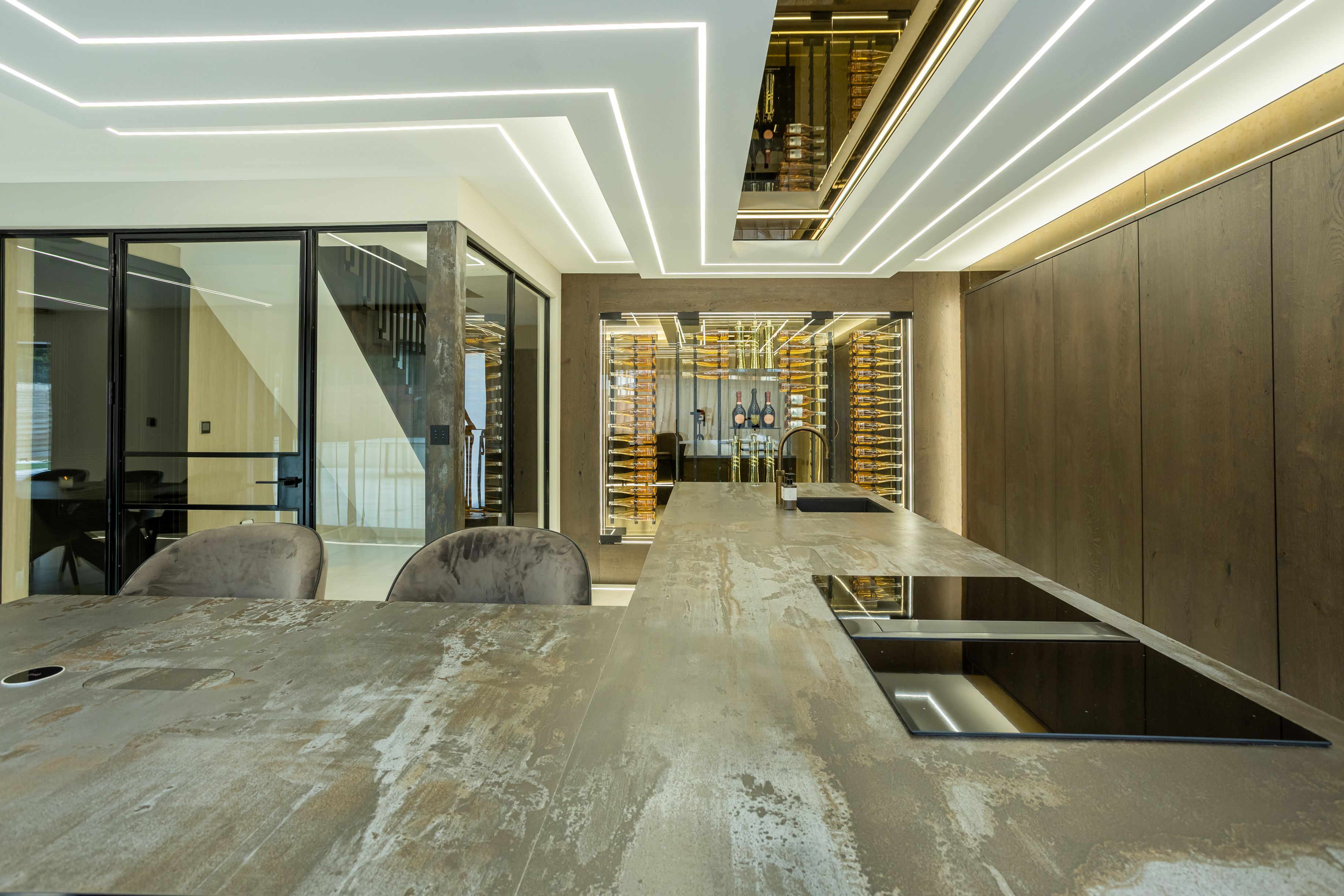
The best material for a luxury kitchen is the one whose appearance, performance, maintenance, fabrication and ageing characteristics suit the household and the design. Price or country of manufacture alone does not answer that question.
Worktops, cabinetry and bespoke joinery should be considered together. The worktop must suit cooking and cleaning, the cabinetry must support storage and appliances, and the joinery must connect those elements with the architecture and surrounding spaces. The selection needs to be made product by product, with samples, technical information, edge details, joints, care instructions and installation requirements reviewed before approval.
This guide provides a structured way to compare options without promising that any material is indestructible or maintenance-free.
Before choosing a worktop, cabinet finish or bespoke joinery detail, compare it against eight questions:
The answer should be recorded in the project specification and care information, not left as a verbal impression formed from a small sample.
A sample helps assess colour, texture and reflectivity. It does not demonstrate how the complete kitchen will perform.
The brief should establish:
These answers create a performance brief against which materials can be assessed.
Worktops are exposed to heat, moisture, food, cleaning products, impacts and concentrated loads. Their suitability depends on the exact product, finish, thickness, fabrication and support.
Natural stone offers genuine geological variation. Each slab should be viewed and approved because veining, fissures, colour and structure can vary.
Points to assess include:
Marble, quartzite, granite and other stones should not be treated as one interchangeable category. Ask an experienced stone supplier and fabricator to confirm the suitability and care requirements of the actual stone and finish.
These manufactured slab materials can provide low porosity, large formats and a controlled visual range. Product claims and instructions still vary by manufacturer, collection, finish and thickness.
Review:
For example, Cosentino's Dekton care guidance describes daily cleaning, restrictions on certain chemicals and precautions around prolonged heat or direct flame. It also states that chipped edges may sometimes be repairable while cracks usually are not. These are manufacturer statements for a named product, not evidence that every sintered surface performs identically.
Engineered quartz can provide colour consistency and a broad decorative range. The resin content, finish and manufacturer's installation guidance matter.
Check:
Do not assume that guidance for one quartz brand applies to another.
Solid-surface materials can offer inconspicuous seams, formed details and, for some products, repair or refinishing options.
Assess:
The ability to refinish a product does not remove the need for correct day-to-day use.
Metal can be hygienic, precise and appropriate for intensive preparation areas. It will normally develop marks and a changing surface character through use.
Consider:
Timber adds warmth and can sometimes be repaired or refinished, but its response to water, heat, cleaning and movement must be understood.
Review:
Timber may be more appropriate as a secondary surface or furniture element when the household does not want its maintenance demands across the principal preparation area.
The material name is only one part of the specification. The design should also define:
A large island can be constrained by slab size, access, weight and support. The preferred appearance needs to be reconciled with a fabricator's technical requirements before the design is released.
.png)
Meiger uses Dekton by Cosentino where its performance and appearance suit the project. This ultra-compact surface combines high resistance to heat, scratching and everyday stains with very low porosity. Its colour and texture collections include contemporary stone-inspired designs and matt, polished, velvet and textured finishes, subject to the chosen colour and collection.
For a kitchen intended to endure, we consider the finish alongside slab layout, edge profiles, joints, support and fabrication. Cosentino’s care guidance remains part of the specification: strong surface performance still requires correct installation and care, particularly at exposed edges.
Meiger also works with Porcelanosa products where they suit the brief. Its surface and kitchen collections include XTONE large-format porcelain and natural-stone options, offering different ways to coordinate worktops with cladding, flooring and adjoining interiors. We select the named product and finish for its intended application, with representative samples and fabricator-approved details.
Arrital has designed and manufactured kitchens and living spaces since 1979. Meiger works with this Italian cabinetry partner where its design systems, finishes and technical options suit the home. The kitchen can then be developed with connected living spaces and separately specified worktops and bespoke joinery, rather than treated as an isolated cabinet arrangement.
The trust in a supplier relationship comes from clear specification and support: named products, approved samples, coordinated drawings, manufacture and installation responsibilities, care information and aftercare arrangements.
Cabinetry should be assessed as a system rather than a door colour.
The specification may include:
German and Italian cabinetry can offer sophisticated engineering, finish libraries and integrated systems. The meaningful question is which manufacturer, range and components have been specified and how they meet the project brief. Country of origin should not be used as a substitute for technical evaluation.
Meiger often prefers appropriately specified MDF for painted cabinet fronts and bespoke joinery because its uniform structure supports precise cutting, routing and profiling. It offers flexibility in panel dimensions and shaped details, helping cabinetry fit the proportions of the room.
Its smooth substrate can support painted, lacquered, veneered or laminated finishes, allowing a broad range of colours, textures and visual effects. The visible texture comes from the selected finish, while the MDF provides the underlying form. Durability depends on the board grade, thickness, edge sealing, coating, fixings and exposure, rather than the material name alone.
For interior areas exposed to humidity, specify a suitable moisture-resistant grade and fully sealed edges and faces. Moisture-resistant MDF is not waterproof and should not be used as a general outdoor cabinetry material. For indoor comfort, request documented low formaldehyde-emission performance for the selected board and compatible finishes instead of assuming every MDF product has the same emissions.
MEDITE’s moisture-resistant MDF guidance illustrates the machining, finishing and emission information to request from a board supplier. This is a specification reference; the actual manufacturer and grade should be identified in the project proposal.
Timber provides natural variation and tactile depth. Veneer can use valuable timber efficiently and create visual continuity across panels, while solid timber may suit particular frame and detail applications.
Confirm:
Natural variation should be presented as a material characteristic rather than a defect or a promise of perfect uniformity.
Lacquer can provide controlled colour and different sheen levels. Finish quality depends on the substrate, preparation, coating system and curing.
Compare:
Modern decorative boards and laminates offer extensive colour, texture and performance choices. Suitability depends on the exact product and correct edge and moisture detailing.
EGGER, for example, publishes care guidance for its decorative surfaces. Its laminate-worktop advice highlights care around edges and joints. Use the instructions for the specified surface rather than a generic internet remedy.
Review:
Specialist materials can create a distinctive architectural result but may introduce weight, fragility, fabrication and replacement considerations.
Confirm compatible hinges and supports, safe edge treatment, cleaning, tolerances and how an individual damaged panel would be replaced.
Bespoke joinery is fitted furniture designed and made for a particular brief and space. Its value comes from resolving dimensions, storage, material continuity and architectural details that a standard unit alone may not address. The word bespoke should be explained through the drawings and specification: a selected cabinet system with custom infill panels is a different scope from furniture made to individual dimensions throughout.
Depending on the agreed commission, joinery can extend from the kitchen into a pantry, utility room, breakfast area, dining space or lounge. It may include a dresser, banquette, drinks cabinet, concealed storage, wall panelling or shelving. Each element should have a purpose and a clear relationship to how the household uses the home.
An established cabinetry system and individually made joinery can work together. The design should identify where each approach is used, who manufactures it and how finishes, tolerances, hardware and warranties are coordinated. Custom-made furniture is not automatically better for every task; the appropriate choice follows the brief, engineering, budget and aftercare needs.
The visible finish and the underlying construction are separate decisions. A timber appearance may be achieved with solid timber, veneer over a specified substrate, or a decorative surface. Record exactly what is proposed rather than relying on a description such as oak finish.
Review:
The joinery maker should confirm the construction and manufacturing details. Appliance ventilation, electrical equipment, heavy surfaces and any structural supports also require input from the responsible specialists.
In a larger kitchen interior, joinery can create continuity between cooking, dining and living areas without giving every room the same storage arrangement. A pantry may need practical access and durable internal finishes, while a dining dresser or lounge cabinet may place greater emphasis on display, proportion and lighting.
Coordinate grain and finish transitions, door and drawer alignments, shadow gaps, handles, integrated lighting and the relationship to ceiling and floor lines. Approve representative finish samples and key details before manufacture. Where furniture must fit between unfinished walls or beneath a new ceiling, agree when final measurements will be verified and who controls subsequent changes.
As more rooms are included, the number of interfaces, approvals and installation visits can increase. The joinery programme should align with the wider house project, including access, building readiness, decoration and protection of completed finishes. Confirm the actual lead time with the appointed maker after the scope and details are agreed.
The quality of a kitchen is experienced through repeated actions: opening a heavy drawer, reaching pans, clearing waste, accessing a corner and returning small appliances to storage.
Evaluate:
Accessories should follow an inventory and the household's routines. Adding mechanisms without a defined purpose increases complexity without necessarily improving the kitchen.
Ask each supplier or fabricator for the current care document for the exact product and finish.
The client should understand:
Terms such as stain-resistant, scratch-resistant and heat-resistant do not mean stain-proof, scratch-proof or immune to installation damage. The manufacturer's limitations and warranty exclusions matter as much as its headline benefits.
Worktops, fronts, floors, metals and walls influence one another. Review representative samples together and, where feasible, in the intended orientation and lighting.
Look for:
Photorealistic 3D renders can communicate composition and scale when included in Meiger's appointment, but they do not replace physical samples, technical documentation or slab approval.
Longevity depends on the design's capacity to be maintained as well as the initial material.
Before approval, ask:
No responsible specification can promise that a family kitchen is bullet-proof. It can reduce avoidable risk through suitable products, good detailing, qualified fabrication, careful installation and clear maintenance.
Outdoor use changes the performance brief. UV exposure, rain, freeze-thaw conditions, heat, ventilation, fixings, corrosion, covers and winter maintenance all need consideration.
Only use a product outdoors where the manufacturer approves the exact material, finish and application. The cabinetry structure, fixings, appliances and services also need outdoor suitability; an outdoor-rated worktop alone does not make the whole kitchen suitable.
For every shortlisted worktop or cabinet finish, record:
Meiger considers cabinetry, worktops, bespoke joinery, hardware, appliances, lighting and connected interiors within the agreed scope. Each material choice should support the household's routines and the architecture of the home.
Based in Alderley Edge, Cheshire, Meiger can discuss how those elements fit your project brief. The comparison principles in this guide are also useful for readers elsewhere in the UK; confirm the proposed scope and delivery arrangements for your property with the studio.
Explore Meiger's luxury kitchen design service, read the bespoke kitchen planning checklist, review the kitchen-island sizing guide, browse luxury kitchen projects, or contact the studio.
There is no single best material. The correct choice balances the household's use, desired appearance, cleaning tolerance, fabrication, repair expectations and the manufacturer's technical requirements.
No. Manufacturers publish strong performance claims for particular products, but their care documents also address edge chipping, cracks, chemicals, heat precautions and correct installation. Review the exact product guidance and use a qualified fabricator.
Country of manufacture does not decide suitability on its own. Compare the named manufacturer and range, cabinet construction, finish, hardware, internal accessories, technical support, warranty and fit with the project brief.
Maintenance varies by stone type and finish. Some stones may require sealing or more care with acids and stains. Approve the actual slab and obtain stone-specific advice from an experienced fabricator.
It depends on the construction, finish, manufacturer support and colour consistency. Replacement strategy should be discussed before ordering, particularly for specialist finishes or continuous grain matching.
Cabinetry describes the cabinet units and their construction, fronts, hardware and storage systems. Bespoke joinery describes fitted furniture made for a particular brief and space, which can include cabinets as well as panelling, shelving, seating and other features. Ask the proposal to identify which elements use a manufacturer system and which are individually made, with their respective specifications and responsibilities.
It can require additional design, detail approval, manufacture and installation time. The duration depends on the maker, materials, complexity, number of spaces and readiness of the building. Joinery within a whole-house project must be programmed alongside the wider construction work.
No. Renders help communicate design intent, scale and relationships, but screens, lighting simulation and digital textures cannot guarantee the appearance of a physical product. Final approval should use current samples and, where relevant, the actual slab.
Manufacturer guidance applies to its named products. These references are not a statement that every brand is specified by Meiger. Obtain current technical and care documents for the products included in your own project.


