Some homes are designed to impress. This one was designed to disappear — into the coastline, into the light, into the unhurried rhythm of tides. When a discerning client approached Meiger Design Studio with the vision for their second residence, the conversation was less about square footage and more about feeling. The result is a sanctuary that redefines what it means to retreat.
"We didn't want another statement house. We wanted somewhere that makes you exhale the moment you walk in. Luxury through restraint. A connection to the ocean that feels effortless — not staged. Somewhere you forget time exists." - the client shared
The guiding architectural principle at Meiger Studio was deceptively simple: remove every barrier between the inhabitant and the horizon. The living room occupies a double-height volume of near-theatrical proportion, its ceiling rising to expose a grid of structural beams — honest, warm, and deliberately understated against the vast glass walls that frame the turquoise beyond.
Floor-to-ceiling glazing on the ocean façade eliminates the conventional wall entirely. There is no threshold between living space and terrace — only a seamless continuation of travertine tile that flows from interior to exterior, as though the house itself is dissolving into the sand. This is architecture as meditation: every design decision engineered to draw the eye outward and the breath deeper.
The floating glass-and-oak spiral staircase — perhaps the residence's most celebrated gesture — rises through the double-height void as sculpture rather than structure. Its helical form mirrors the gentle spiral of a nautilus shell, casting ever-changing shadows across the stone walls as the sun moves. It does not merely connect floors; it animates the entire volume, transforming vertical circulation into an event of pure sensory pleasure.
"The staircase is not a means to reach the upper level — it is a reason to pause, to look up, to be reminded that beauty can exist in the most functional of forms."
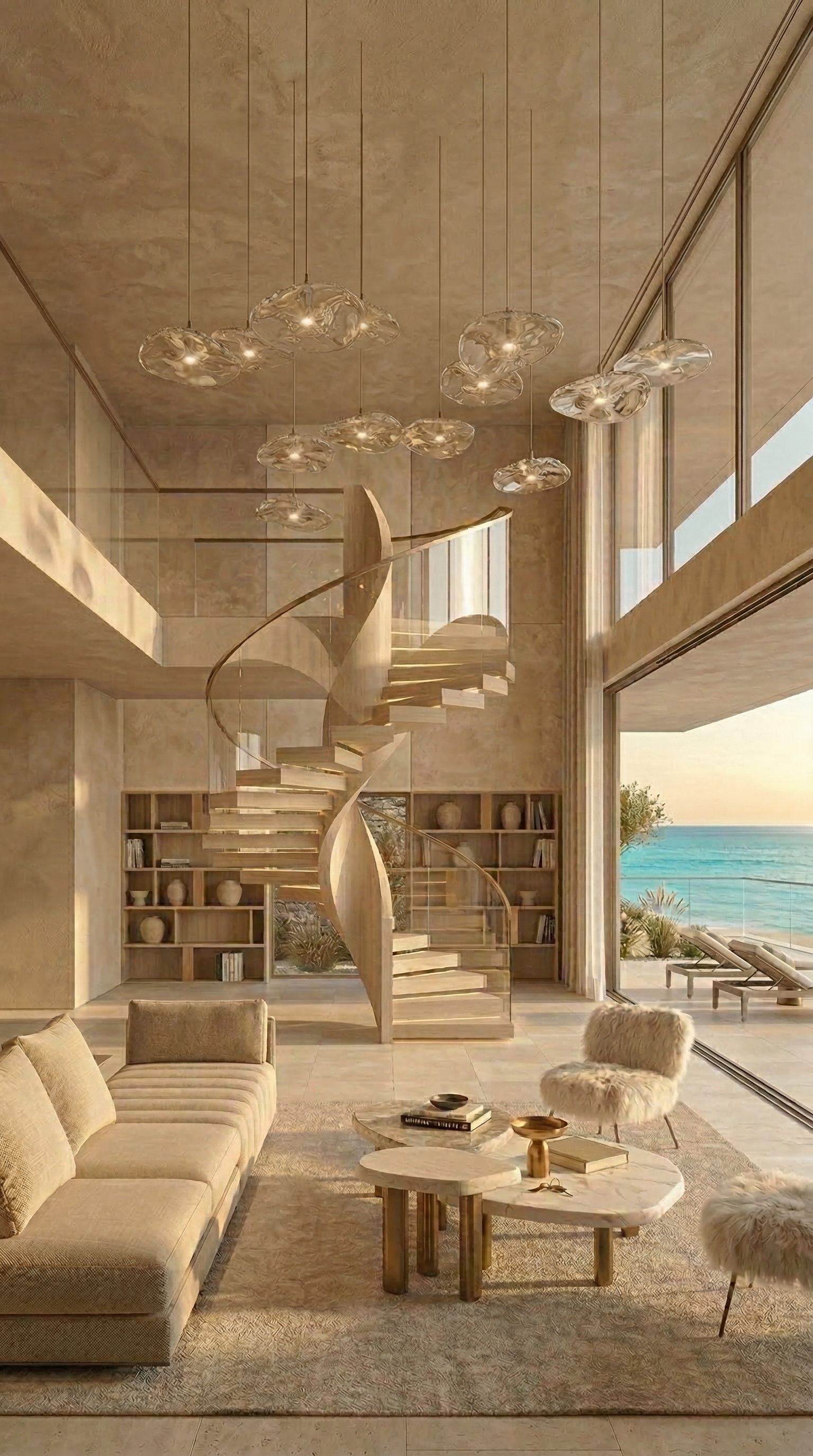
Nested at the base of the staircase, sheltered from the open expanse of the living room yet never closed from it, a built-in library curves gently along the interior wall. Dark-stained oak shelving — warm, tactile, deeply grained — provides a foil to the room's prevailing palette of sand and limestone.
The fur-upholstered lounge chair positioned here is not an afterthought. It is the destination: a chair that invites you to stay for hours, a bowl of warm light spilling from the floor lamp beside it, the ocean glittering in the glass beyond. The pouf at its feet completes a vignette of unhurried, deliberate comfort that speaks directly to the client's brief.
On the opposite wall, a second tall cabinet runs flush beneath the staircase's underside — its dark-toned panels echoing the library in material and depth, creating a sense of enclosure without ever feeling confined. Together, the two flanking elements frame a space-within-a-space: a chilling corner of rare intentionality.
At its centre, a shearling lounge chair faces the ocean directly — positioned not by accident but by design, angled so that the eye travels naturally from the curve of the stair, past the slim floor lamp and its burnished brass bowl, and out through the floor-to-ceiling glass to the beach and sea beyond. A linen pouf rests at its feet. A small side table holds whatever the afternoon calls for. This corner asks nothing of you except that you sit, look outward, and stay longer than planned.
.jpg)
In a project defined by restraint, material selection carries the full expressive weight of the design. Meiger's team spent months curating a palette that responds to the coastal environment without mimicking it literally — one that reads as timeless rather than themed, elemental rather than decorated.
Soft furnishings were sourced with equal rigour. Cream-toned bouclé, ivory shearling, and raw linen form the tactile vocabulary of the seating zones — fabrics that invite touch, that soften the geometry of the architecture, and that hold the warm, diffused light of a coastal afternoon in their fibres. Nothing synthetic. Nothing that would not, over time, become more beautiful.
.jpg)
If the living spaces are defined by their lightness — by stone and cream and open sky — then the kitchen-dining zone offers a deliberate counterpoint. Here, Meiger's designers introduced a darker register: smoked oak cabinetry, deep-grained and almost black in certain lights, grounds the composition with a gravitas that prevents the house from drifting into pure reverie.
Against this depth, the Calacatta marble countertop and backsplash emerge with dramatic clarity — its bold grey veining threading through luminous white stone with the confidence of brushstrokes. Under-shelf LED lighting casts a warm amber glow that transforms the kitchen wall into something approaching a painting: functional, beautiful, and completely irreplaceable.
The oval dining table — travertine-topped, resting on a tapered brass pedestal — anchors the dining zone with sculptural authority. Around it, dark-framed bouclé chairs provide the softness the stone requires.
There is a particular kind of luxury that has nothing to do with expense and everything to do with intention. It is found in the way morning light moves through unfilled travertine. In the resistance of a solid oak stair tread underfoot. In the silence of a room where nothing competes with the sound of the sea.
This residence — Meiger Studio's most fully realised coastal project to date — achieves what the client asked for and what great residential design always aspires to: it makes you feel that you have arrived somewhere rare. Not because of what it contains, but because of what it removes. Every extraneous thing has been edited away until only the essential remains: light, stone, wood, water, and the particular peace of a house that knows exactly what it is for.
*The visuals and spaces presented here represent a design concept in development by Meiger — not a completed or built project.